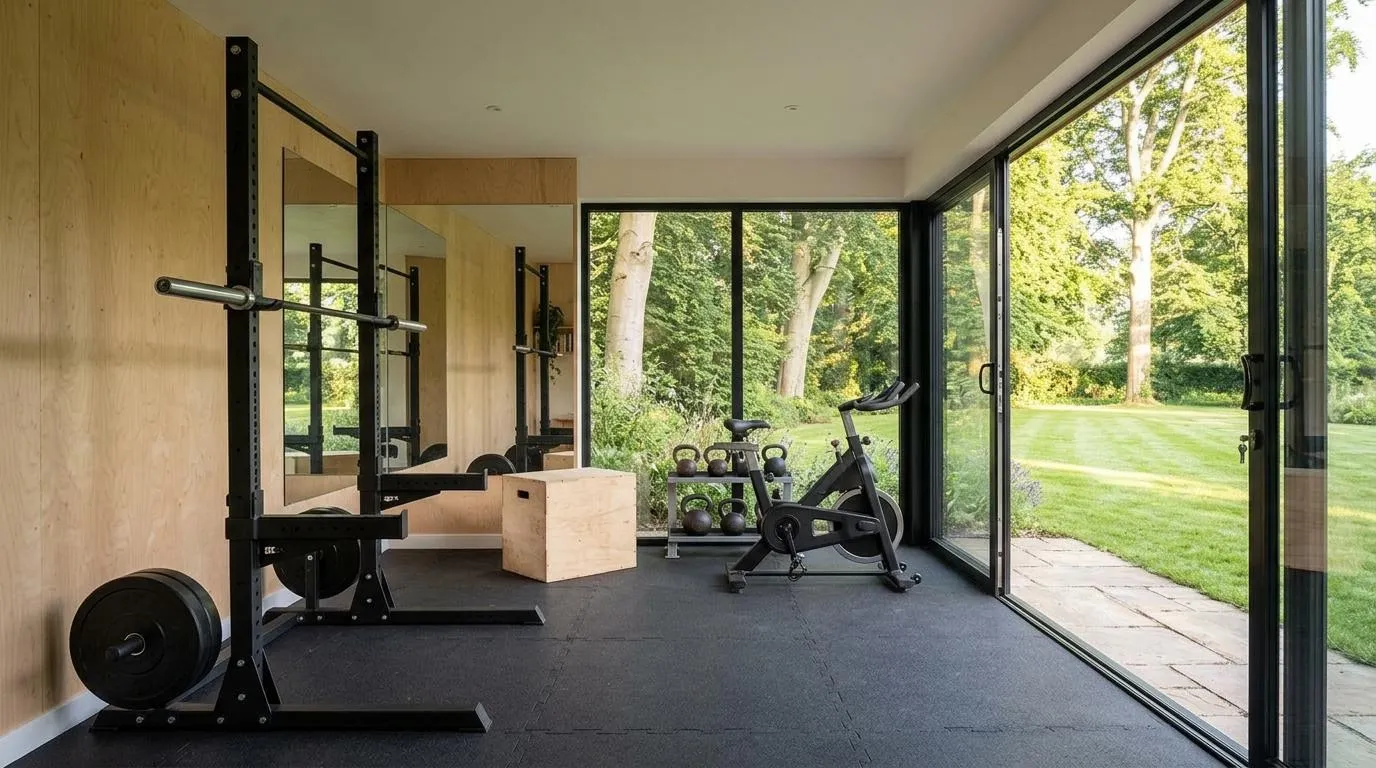
Why gyms get damp
Hard training adds moisture to the air from breath and sweat. In a well-insulated room, the glass and any cold spots are the coldest surfaces. Warm, damp air meets them and turns to water. You see it as misted windows, wet frames and, later, black spots on walls.
This is condensation. It is different from a leak or rising damp. The fix is different too.
Check the cause first
- Water on the inside of the glass after a session: condensation.
- Wet patches that do not follow the weather and the use of the room: look for a leak.
- Damp low on a wall or floor: look at ground moisture and the base.
What the rules say
Approved Document F is the ventilation guidance for England. Its Volume 1 covers dwellings and Volume 2 covers buildings other than dwellings. A small gym outbuilding with no sleeping space is normally exempt from building regulations under the Planning Portal thresholds, so Part F may not apply formally. It is still a good guide to what a healthy room needs.
The Planning Portal's guidance on doors and windows says rooms that produce steam, such as kitchens, bathrooms and utility rooms, need higher ventilation, usually mechanical fans and windows. Other rooms may use suitably sized openings and trickle ventilators. A gym is closer to the first type than the second.
Ventilation that works
Background ventilation
A small, constant flow of fresh air. Trickle vents in the window frames do this. They keep air moving even when the room is empty.
Extract fan
A fan removes moist air at the source. In a gym, ask for a fan that can be switched on during training and left to run after. A timer or humidity sensor can run it for you. Fans need a power supply, which is part of the room's electrics. See building regulations for garden rooms.
Opening windows and doors
Opening a door and a window on opposite sides gives fast cross-ventilation. It costs nothing. Plan the layout so that these openings are not blocked by kit.
Roof lights that open
Warm moist air rises. An opening roof light lets it out. It also adds light. See garden room glazing for the trade-offs.
Heating and insulation
Cold surfaces cause condensation. A room that is insulated well and kept at a steady, modest temperature has fewer cold spots. A room that is heated hard for an hour and then left to go cold sees more condensation. Ask your builder about heating that suits how you use the room.
Glass is usually the coldest surface. Better glazing helps. Check the glass specification when you compare quotes.
Equipment and storage
- Do not store wet towels or kit in the room.
- Leave a gap between racks and the walls so air can move.
- Wipe down the glass after a hard session, if it mists.
- Open the door for a few minutes after you finish.
Keep rain out of the walls
Condensation inside is one issue. Water getting into the walls from outside is another. A Scottish Government guide on timber cladding says detailing is the first line of defence against decay. It recommends a drained, back-ventilated cladding cavity, so water that gets in can drain away and the cavity can dry. It also says to keep timber clear of the splashline. Ask your builder how the cladding is detailed. See garden room maintenance and lifespan.
The floor
A timber floor should stay dry. Ask how the underside is ventilated and protected. Moisture from the ground, plus rubber flooring on top, can cause problems. See garden gym flooring.
Questions to ask builders
- How is the room ventilated when closed up?
- Is there an extract fan, and how is it controlled?
- What glazing is included?
- How is the wall build-up protected from damp?
- Is there a vapour control layer, and where?
Cost
We do not give prices here. Ventilation is part of the specification. Use the garden room cost calculator and read garden room costs.
Local builders
We have pages for Tring, Kings Langley, Harpenden and Beaconsfield. See also garden gyms and garden studios.
Quotes for a well-ventilated garden gym
We match you with up to 3 local builders. It is free for homeowners. See garden gyms in Herts and Bucks.