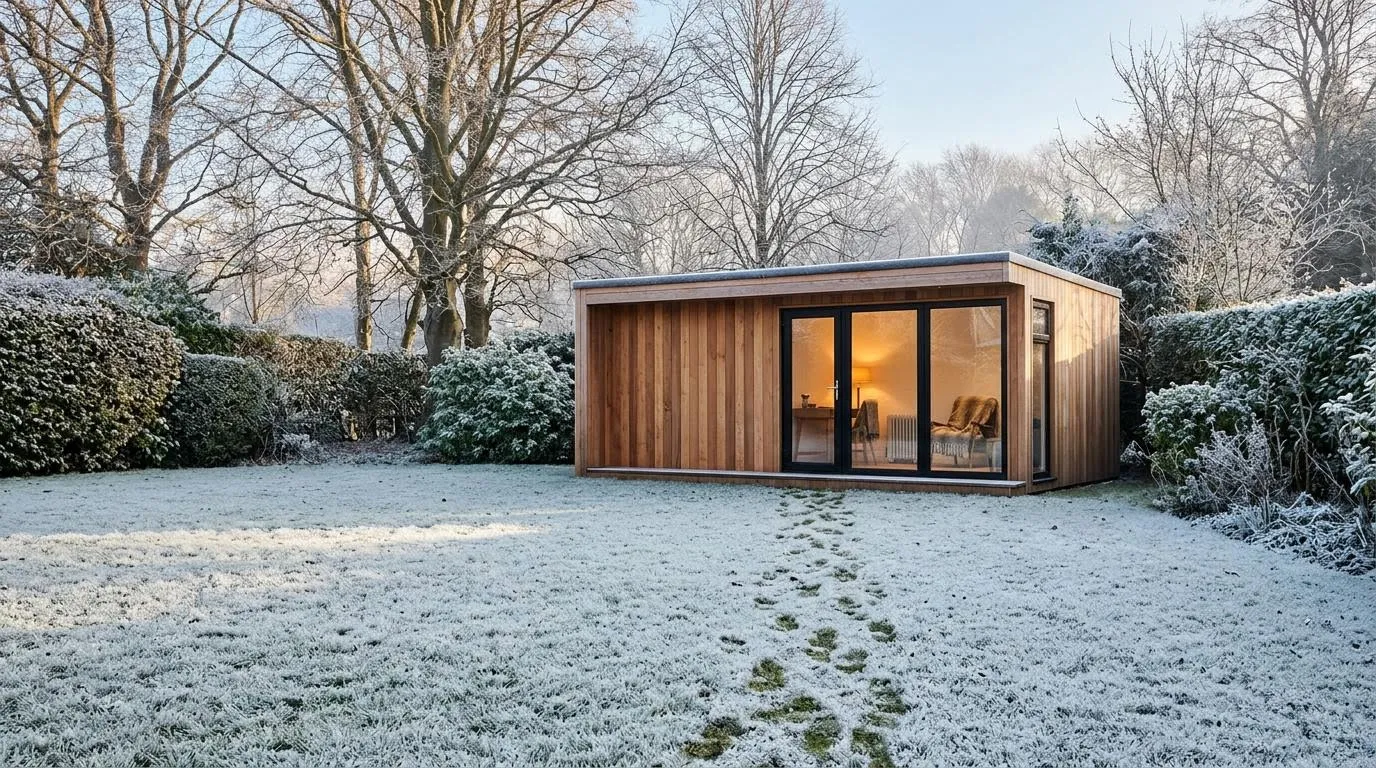
Why insulation decides how much you use the room
A garden room is a small box with a lot of outside surface. Heat leaves through the floor, walls, roof and glass. Without insulation you will only use it in mild weather.
With good insulation and a tight build, a small heater keeps it comfortable in winter. In summer the same layers slow the heat from the sun. This is what turns a summerhouse into a garden office you can work in all year.
Where the insulation goes
- Roof. Heat rises, so the roof matters a lot. Ask what the roof is made of and how thick the insulation is.
- Walls. The insulation sits between the timber studs, and often has a further layer over them to cut thermal bridges.
- Floor. A cold floor makes a room feel cold. Underfloor insulation is worth asking about, especially over a ventilated void on ground screws. See garden room foundations.
- Glazing. Doors and windows are usually the weakest part. Ask about double or triple glazing, and about the size and direction of the glass.
Draughts count as much as insulation thickness. Ask how the builder seals joints and where the doors meet the frame.
Common insulation types
Builders use rigid foam boards, mineral wool and natural fibre boards. Each has trade-offs in thickness, cost, fire performance and how it handles moisture. A thicker wall gives better insulation but a smaller room inside, and it can matter when you are close to a height or size limit.
Ask for the product name, the thickness in each part of the building, and the manufacturer's data sheet. A good builder can give you this at once.
Damp, condensation and air
An insulated, sealed box can trap moisture from breathing, drying clothes or a kettle. Poor detailing leads to condensation and mould.
- Ask how the wall and roof layers are built to let moisture escape or stay out.
- Ask how the floor is ventilated.
- Ask about trickle vents, opening windows or a small extract fan.
Untreated timber cladding is a design choice, not a flaw. It fades to silver-grey over a few years. See garden room cladding options.
Insulation and the rules
You do not need building regulations approval just because a room is insulated. The Planning Portal says detached outbuildings are normally exempt if they are under 15 m² and have no sleeping accommodation. Between 15 m² and 30 m² they are normally exempt if nobody sleeps in them and the building is at least 1 m from every boundary or built mostly of non-combustible materials.
A room with a bed is not exempt at any size. If you plan an annexe, the energy and structure rules apply. Read building regulations for garden rooms and garden annexe rules.
Insulation also adds wall thickness. Height limits apply to the finished building, so a thick roof build-up takes height from the inside. See the planning permission guide.
Insulation and heating go together
The better the insulation, the less heating you need and the smaller the heater can be. Plan the two together. Our heating and air-con guide covers the options.
Questions to put to builders
- What goes in the floor, the walls and the roof, and how thick is each layer?
- What are the glazing specification and the frame material?
- How do you stop draughts and condensation?
- Can you show a similar room that people use in winter?
Builders in Harpenden, Hemel Hempstead and Gerrards Cross make year-round rooms every week. Insulation spec changes the price, so see the garden room cost calculator and how a price is built. Related: garden studios.
Common mistakes
- Insulating the walls but not the floor. Feet get cold first.
- Too much glass on the sunny side. Pretty, but hot in summer and cold in winter.
- No ventilation plan. A sealed room with no air movement gets stale and damp.
- Comparing only wall thickness. Compare the whole build: floor, walls, roof, glazing and draught sealing.
- Assuming a year-round claim. Ask to see a room that has been used through a winter, and ask the owner how it felt.
Ask the builder to put the insulation specification in writing, with the same level of detail in every quote you compare.
Want a room that works in winter?
Tell the builders you want year-round use. Up to 3 local builders quote, with the insulation spec written down. It is free for homeowners.