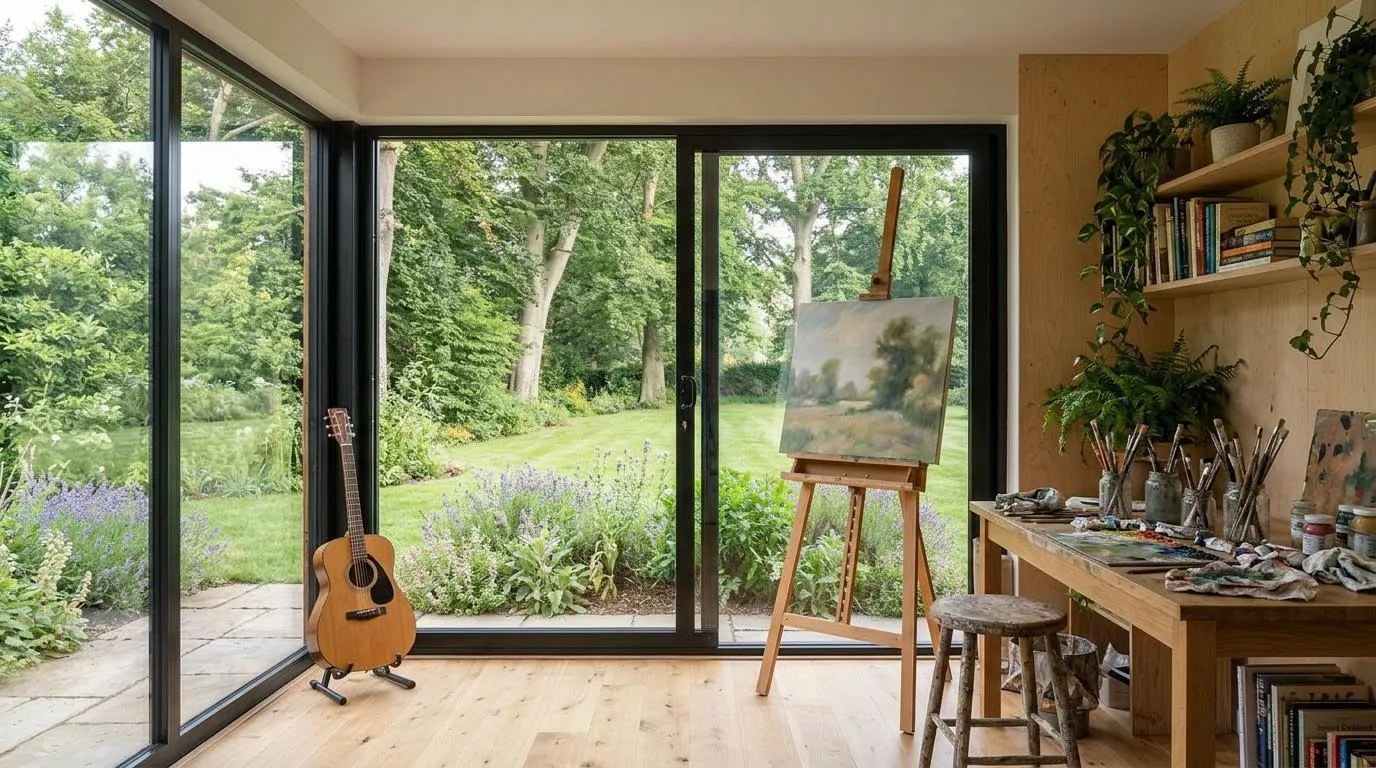
Start with a goal
"Soundproof" can mean many things. A podcast booth needs less than a drum kit. Decide what you are protecting and from whom.
- Quiet for you, from the street or the house.
- Quiet for the neighbours, from your guitar or drums.
- A good-sounding room inside, for recording.
For loud instruments, ask an acoustic consultant before you build. The advice below is general. It is trade guidance, not a measured design.
What the law says about noise
GOV.UK says a statutory noise nuisance is noise that unreasonably and substantially interferes with the use or enjoyment of a home or other premises, or injures health or is likely to. Councils must investigate complaints about possible nuisances from premises, including gardens. If there is a nuisance, the council must serve an abatement notice.
Between 11pm and 7am councils can also issue warning notices for noise above set levels, even if it is not a statutory nuisance. GOV.UK gives the permitted level as 34 dBA if background noise is 24 dBA or less, or 10 dBA above the background noise otherwise. Non-compliance can lead to a fixed penalty notice, prosecution or removal of equipment.
So the law does not set a simple rule for the day. The test is "unreasonable and substantial". At night the rules are tighter. Good design keeps you well inside both.
The five principles
A trade guide for musicians sets out the core ideas. We summarise them here.
1. Mass
Heavy, dense materials resist vibration, so less sound passes through. An extra layer of board is an example.
2. Decoupling
Separating the parts that touch stops vibration crossing. Methods include resilient channels, isolation clips, floating floors and a room-within-a-room. It matters most for bass and drums.
3. Absorption
Porous material such as mineral wool absorbs sound inside wall cavities. It curbs resonance. It does not block sound by itself.
4. Damping
Damping compounds sit between layers of board and turn vibration into tiny amounts of heat. The guide says they help with bass.
5. Airtightness
Small gaps leak more sound than most people expect. Use door seals and acoustic sealant around frames, sockets and pipe entries.
Part by part
Door
The guide says hollow doors are a major leak, and a solid core door with good seals is the upgrade. The door is usually the first thing to fix. Two doors with a gap between them can do better than one. Glass doors let more sound out than solid walls. If you use glass, choose where it faces.
Walls and ceiling
Sound leaks up as well as sideways. The guide suggests resilient bars with damped board for ceilings. Ask your builder what the wall and roof build-up is made of.
Floor
Footfall and kick drum impact travel through the structure. A floating floor is the strongest fix, says the guide. A thick rug with dense underlay helps with mid and high sounds but does little for bass.
Windows
Glass is a weak point. Fewer, smaller windows that face away from neighbours help. Fixed panes seal better than opening ones. See garden room glazing.
Ventilation
Ducts carry noise. Lining them or fitting acoustic covers helps, though airflow drops. A studio still needs fresh air, so do not seal it fully. For the moisture side, see ventilation and condensation.
Flanking paths
Sound goes round good walls through shared vents, service risers and gaps. These need treating too.
Position matters
Distance is free soundproofing. Put the studio at the far end of the garden, away from the neighbours' bedrooms. Face doors and windows towards your own house or an open space. The outbuilding rules still apply: a building must not sit forward of the principal elevation and has height limits, with the 2.5 m limit within 2 m of a boundary.
Planning and building regulations
A studio with no sleeping space under 15 m² is normally exempt from building regulations, say the Planning Portal thresholds. Between 15 m² and 30 m² it is normally exempt if it is at least 1 m from every boundary, or built substantially of non-combustible materials. Extra layers add weight and thickness, so check your floor area and height. See building regulations for garden rooms and planning permission.
If the studio is used for a business with clients, ask your council. Our garden studios page has more.
Home workers who need a quiet office should also read about garden offices.
Cost
We do not give prices here. Sound control adds layers, doors and detailing. Use the garden room cost calculator and read garden room costs.
Local builders
Ask for a written sound specification from builders in Amersham, St Albans, Berkhamsted and Gerrards Cross. A good builder will tell you what they can and cannot promise.
Steps to take
- Decide what you need to protect, and from whom.
- Choose the spot furthest from neighbours.
- Ask for a solid door, sealed gaps and a decoupled floor.
- For drums or amps, book an acoustic consultant.
- Tell the neighbours before you start.
Quotes from garden studio builders
We match you with up to 3 local builders. It is free for homeowners. See garden studios in Herts and Bucks.