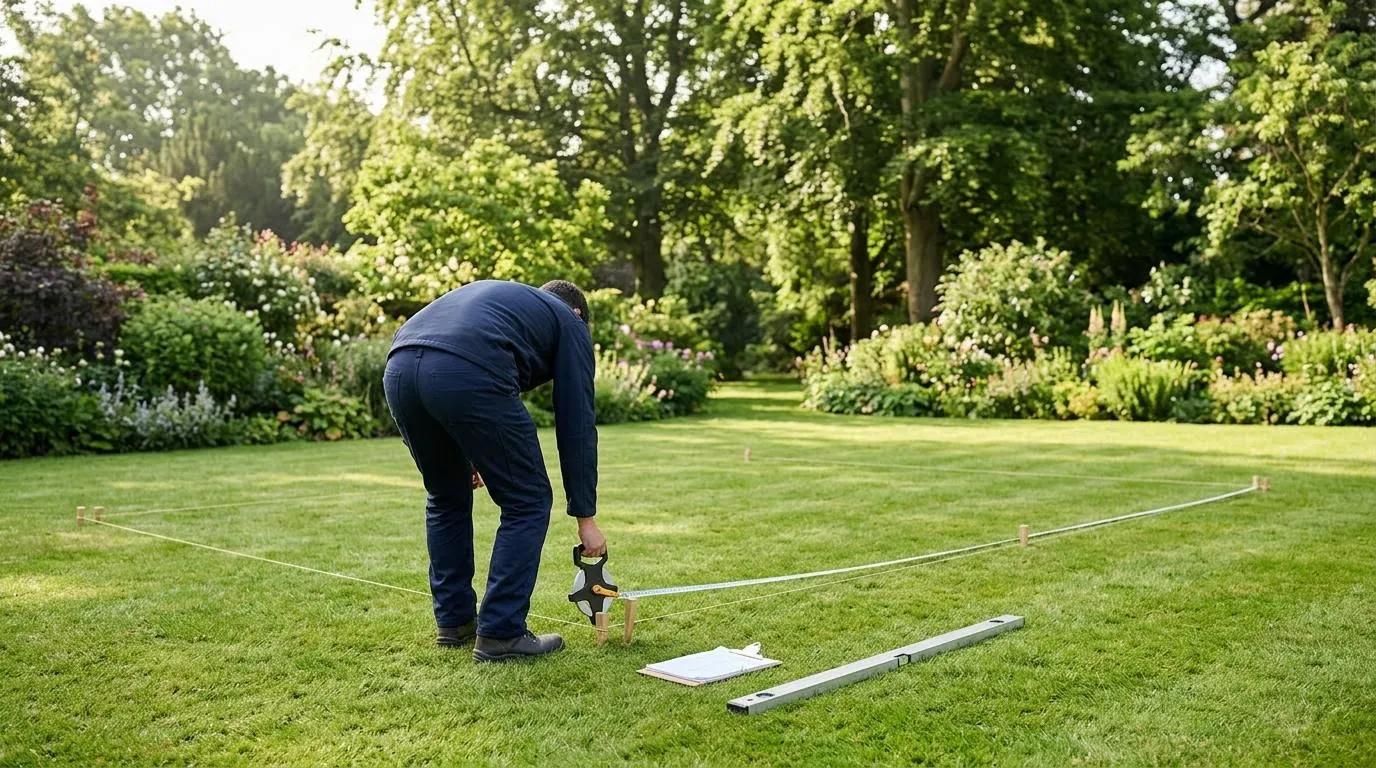
The order of events
- Decide the use, size and budget.
- Check the planning position.
- Get quotes and a site visit.
- Choose a builder and sign a contract.
- Planning and building control, if needed.
- Groundworks and base.
- Build, services and finishing.
- Inspection, sign-off and handover.
We do not give weeks for the build steps. They vary too much. The official steps have published limits, and we give those below.
1. Decide what you want
Write down the use, who will use it, and what must be inside. An office, a gym, a studio and an annexe have different rules. See garden annexe rules if anyone will sleep there. Use the garden room cost calculator for a budget guide.
2. Check planning first
Many garden rooms fit permitted development, but some do not. The Planning Portal sets the outbuilding limits. A building must be single storey, with eaves no higher than 2.5 m, and an overall height of up to 4 m with a dual-pitched roof or 3 m otherwise. It cannot sit forward of the principal elevation. See planning permission.
If you are not sure, a lawful development certificate is an optional decision that confirms whether a proposal is lawful. GOV.UK does not give a decision time on its page, so ask the council how long it takes.
3. Quotes and site visits
Citizens Advice says to get written quotes from at least three traders. A quote is a fixed price. An estimate is a rough guess. A site visit lets the builder see the access, levels, trees and drains. Pricing without a visit is a guess.
Compare what is included. Look for the base, the electrics, the data duct, the removal of waste and any planning drawings. See how a garden room price is built.
4. Contract and deposit
Citizens Advice says a contract should be in writing before work starts. It should cover timings, tidying up, materials, equipment, subcontractors and payment. Keep any deposit as low as possible and do not agree to more than 25 per cent. Check how the deposit is protected.
Ask for a programme, with a start date and a finish date. Ask what happens if the date slips. See bespoke vs flat-pack for what differs between types.
5. Planning and building control
Planning
The Planning Portal says most planning applications are decided within eight weeks. Unusually large or complex applications have a 13-week limit. If the authority cannot decide within eight weeks, it should get your written consent to extend the period. If it has not, you can appeal for non-determination, though appeals can take several months.
Building control
GOV.UK describes two routes.
- Full plans: a decision is expected within 5 weeks, or 2 months with your consent. Formal approval is issued. A completion certificate usually follows within 8 weeks of the work finishing, if it complies.
- Building notice: only for smaller projects. Work can start 2 days after submission to your building control body. No formal approval is issued.
Many small garden offices are exempt from building regulations. An annexe or a room with sleeping space is not. See building regulations for garden rooms.
6. Groundworks and base
The base comes first. It might be a slab, piles or pads. Trenches for power, data and drains are dug at the same time. Ask for a spare duct. Weather and ground conditions can move this step.
Services can take their own time. A new supply, a drain connection or a pole move may involve other firms. If your room needs a toilet, read garden room with a toilet or shower.
7. Build, services and finishing
This is the step with the least doubt. The frame goes up, the roof goes on, the glazing is fitted, and the inside is finished. The electrician tests the circuits. The deck, paths and lighting come last. Ask for a snagging visit before the final payment. Citizens Advice suggests paying in stages, so problems can be fixed before the final payment.
8. Sign-off and handover
- Building control completion certificate, if required.
- Electrical certificate from your electrician.
- Warranty paperwork.
- Care and maintenance advice. See maintenance and lifespan.
Common causes of delay
- A planning application that is not valid at first.
- Changes after the contract is signed.
- Poor access for deliveries.
- Drains or roots found in the dig.
- Waiting on the electrical supply.
- Bad weather at groundworks stage.
Local builders
Ask builders in Berkhamsted, St Albans, Chesham or Aylesbury for their current programme. Planning offices vary in how busy they are. See also garden gyms, garden studios and garden annexes.
Start with free quotes
We match you with up to 3 local builders. It is free for homeowners. See garden offices in Herts and Bucks.